Castoroides Arizonensis—the Beaver Skull by the High Desert Lake in Prescott, Arizona

It has been a warm and dry winter in the Arizona
high desert. Although my dog feels more comfortable with long trips in the
snow, he still enjoys trips to a nearby lake where he can attempt to disturb
the peace of sitting ducks.
Last week end he put his nose into the soft dirt of
the lake shore and started digging. When I checked what he was doing I saw a
small skull where he had dug. I immediately noticed an orange incisive and knew
it was the skull of a beaver.
So, as a team, we dug a bit and I took the skull
out. It was filled with wet clay and only one orange incisive was still in the
lower jaw. I was about to put things back where they belonged when my dog
looked at me and continued to dig.
We ended up with the jaw, the skull and three
additional incisives, mostly chipped or broken.

Since I had not worked with a beaver skull, and
since this one seemed well preserved, I decided to make it my next
reconstruction project.
Here is the skull, lower jaw and the four incisives:

I was surprised to see the surface “design” of the
pre and full molars. They are a work of art, and surprisingly well preserved.

I initiated a reconstruction of the broken and
chipped incisives. Unfortunately the lines did not match perfectly and I was
unable to re-insert them in the pre-maxillae tunnels, which were also damaged.
It was clear that I had to reshape the original
appearance of the skull and teeth using my imagination.
… As I was inspecting, purely because of my
curiosity, the skull structure, I noticed that the front of the mandibles has a
stereotypic mammalian heart figure that was beyond my creative imagination.
Here is that structure:

Hence, I proceeded with the reconstruction having in
mind a rather prehistoric animal, with orange tusks instead of incisive.
My initial complete “creation” of that new animal
looked like this:

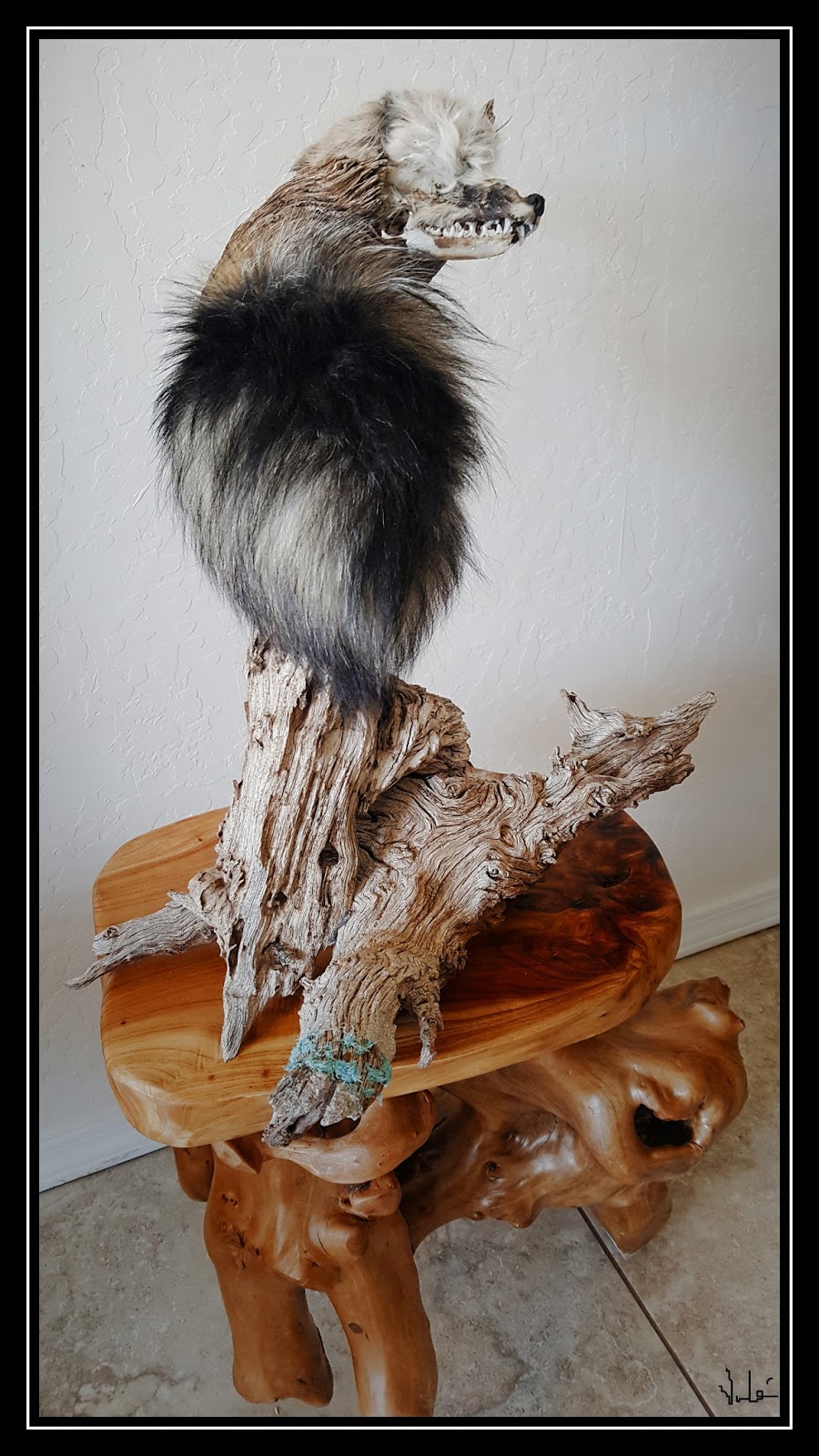
The final touch was to add a hare tail for completing the skull lines, and use a petrified elk vertebrum as a stand:

Now, I had to give this creature a name. An AI
search of the beaver ancestors identified the Castoroides, a distant beaver-like relative from 54 million years ago
(Pleistocene era). In North America,
these were classified as Castoroides ohioensis
8 feet long, over 200 pounds with curved incisors extinct 10,000 years ago.
Since what I
had patched together did not look like a modern beaver, and since my dog found
the skull in Arizona, I humbly named it Castoroides
Arizonensis …!
Finally, I could not ignore the heart shape in the
mandibles, so I found a small turquoise stone shaped almost like a heart. Now
Arizonensis has a Southwestern stone to further justify its name.

The photo at the outset of this blog shows the final
work looking to one of my
paintings on hare skin.
For a similar work on a Peccary skull, see here:
https://vaheark.blogspot.com/2022/03/the-laughing-javelina-cactus-pig-of.html
P.S / An interesting observation: I had to cut with
a small electric cutter, a Dremel, the base of the incisive to fit them back
into the skull. To my surprise, I saw subtle sparks fly during the cutting,
which never happens when I cut bone during work with deer of elk antler.
Can it be because beaver incisive have high concentration
of iron in the enamel (hence their orange colour)?
Maybe one of my readers will help me with this
mystery.
February 12, 2026
© Vahé A. Kazandjian, 2026

Comments
Post a Comment